

Overview
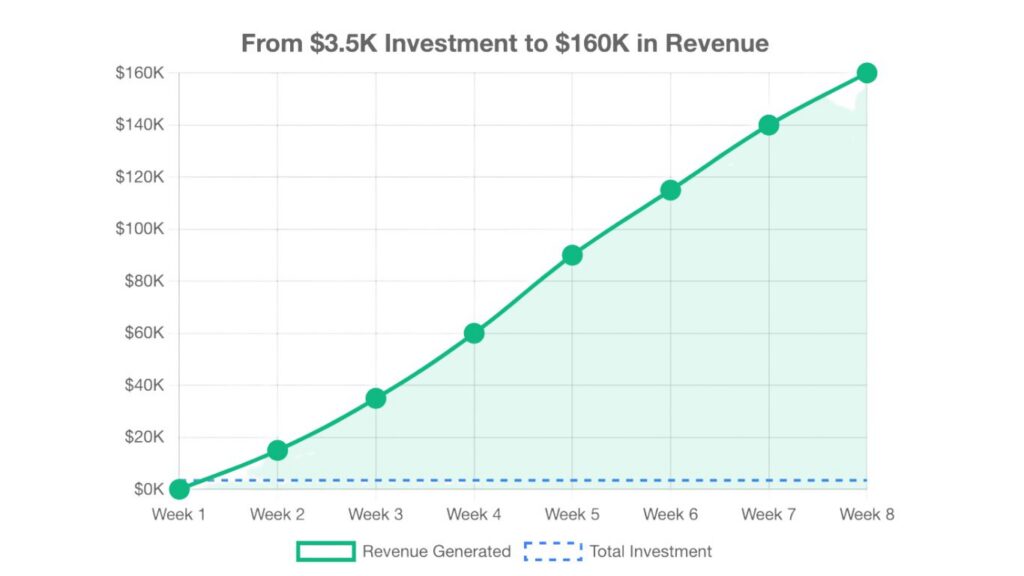
Two agencies had already spent this company’s money without producing work. They gave Google Ads one more try with $3,500 and a short leash. The test produced [FILL 3: number] signed contracts worth $160,000.
A [FILL 1: trucking insurance provider / freight carrier — pick one and use it everywhere] came to me after two agencies had spent their budget without producing business. They put up $3,500 as a final test. I rebuilt the account around the searches freight brokers actually use, wrote ad copy about reliability rather than price, and pointed traffic at a page built to convert rather than a homepage. The test produced [FILL 4] qualified leads and [FILL 3] signed contracts worth $160,000 over [FILL 5: period].
There’s a section further down on what these numbers don’t prove. A 45x return is unusual, and you should understand where it comes from before you take it at face value.
The situationTwo Agencies In, Nothing to Show
This company had done what most owners do. Hired an agency, waited, saw reports full of impressions and clicks, and eventually stopped paying. Then did it again with a second agency and got the same result.
By the time they called me, the position was reasonable: paid search doesn’t work for us, and we’ll spend $3,500 to be proved wrong.
A client who’s been burned twice isn’t buying a strategy. They’re buying whether you’ll tell them the truth when it isn’t working.
That framing changed how I ran it. Everything was built to be checkable week to week, so they could see for themselves whether the money was moving.
What I foundWhere the Previous Budget Went
[One or two sentences on what it meant in practice.]
[One or two sentences.]
[One or two sentences.]
Not one broken thing but three compounding: wrong traffic, arriving at the wrong page, with nothing measuring the outcome. Each report looked plausible because none of them measured business.
The buyerWho Actually Books Freight
Early conversations with the owner made the buyer clear: freight brokers and logistics coordinators who need a reliable carrier quickly. These are repeat buyers under time pressure. They care about capacity, communication, and whether you’ll answer the phone at 4pm on a Friday. They are not comparing carriers on price the way a consumer compares products.
Three consequences for the campaigns:
- Target transactional lane and capacity searches, not general “trucking company” traffic
- Write ad copy about dependability and proof, since that’s the buying criterion
- Send traffic to a page that establishes credibility and coverage in the first screen, not a homepage carousel
The workRebuild, Then Test in the Open
Account structure
Campaigns organized by service type and intent so budget could be traced to a service line rather than averaged across everything. Overlapping keywords separated so campaigns stopped bidding against each other.
Keywords
Transactional, high-commercial-intent terms only — the language a broker uses when they need capacity today. Informational and job-seeker traffic excluded up front through negatives rather than discovered later through waste.
Ad copy
Headlines about reliability and proven delivery rather than generic service claims. The competing ads in this market all say the same four things; saying a fifth thing is most of the advantage.
Landing page
A conversion-focused page replacing the homepage: clear action, service coverage visible immediately, proof points near the top, fast load.
Tracking
Conversion tracking implemented for calls and form fills before launch, so the test could be judged on inquiries and booked freight rather than traffic.
Then: active management, not set-and-forget
Through the test I reviewed queries and conversions continuously, paused what wasn’t producing, and moved budget toward the keywords that were. On a $3,500 total budget there’s no room to let a losing keyword run for a month before noticing.
The resultsWhat $3,500 Produced
| Metric | Result |
|---|---|
| Ad spend | $3,500 |
| Period | [FILL 5] |
| Clicks | [FILL 9] |
| Qualified leads | [FILL 4] |
| Cost per qualified lead | $3,500 ÷ [FILL 4] |
| Contracts signed | [FILL 3] |
| Average contract value | $160,000 ÷ [FILL 3] |
| Total contract value | $160,000 |
| Return on ad spend | 45.7x |
Contracts signed …………. [FILL 3]
Average contract value … $[FILL]
Total contract value ……. $160,000
Return ………………………. $160,000 / $3,500 = 45.7x
Why the multiple is that large. It isn’t a marketing trick, it’s the economics of freight. One contract is worth tens of thousands of dollars, so a handful of them against a $3,500 test budget produces a number that looks impossible in most industries and is ordinary in this one. A consumer business spending the same amount would need hundreds of sales to reach it.
Individual client result. Performance depends on your market, capacity, pricing, and sales process. Past results don’t guarantee future ones.
Want to know what your own account is producing? That’s a 30-minute call, and you keep the findings either way — including if I tell you the setup is already fine.
Book a 30-minute callStraight talkWhat These Numbers Do and Don’t Prove
A 45x return is the kind of number that got this client burned twice before they called me. So here’s what’s behind it.
- Contract value is not collected revenue. These are signed agreements. Freight gets hauled and invoiced over time, and not every contract runs its full value.
- The multiple is a function of deal size, not campaign brilliance. [FILL 3] contracts at roughly $[FILL] each is what produces $160,000. The campaign’s job was finding the right [FILL 4] people; the economics did the rest.
- Freight is lumpy. One unusually large contract can carry a whole period. Treat this as a single result, not an expected rate.
- There’s no control group. Some of these brokers might have found the company another way. What I can say is what the previous accounts produced, and what this one did.
- One client, one test window. Real and verified, and not a sample size that proves a trend.
None of that undercuts the result. It’s context, and I’d rather you have it before a call than discover it after.
TakeawaysWhat Transfers to Your Business
- High deal values change the math entirely. When one customer is worth tens of thousands, precision beats volume and a small budget can carry a real result.
- Know who’s actually buying. Freight brokers search differently than shippers, and both search differently than job seekers. Most wasted spend in this industry is aimed at the wrong reader.
- The landing page is part of the campaign. A homepage asks a broker under time pressure to go find the thing they wanted.
- Small budgets need more attention, not less. $3,500 has no margin for a losing keyword to run unnoticed for three weeks.
This is the same approach I run for trucking and logistics companies and for law firms.
QuestionsWhat Companies Usually Ask Next
Can I expect a 45x return?
No, and anyone promising one is selling you something. That multiple comes from freight contract values against a small test budget. What transfers is the method: target the searches your actual buyers use, send them to a page built to convert, and measure booked business rather than clicks.
Is $3,500 enough to test Google Ads?
For a business with high contract values and a defined service area, sometimes. It was here. For lower-value services it usually isn’t, because you need enough conversion volume for the bidding to learn from. I’ll tell you on a call which situation you’re in.
What does management cost?
The build is a one-time $1,500. Management after that is $1,500 a month or 10% of ad spend, whichever is greater, on budgets between $5,000 and $15,000. Month to month after the first 90 days. You own the Google Ads account and keep it if we part ways.
We’ve been burned by agencies before. Why would this be different?
Fair question, and the honest answer is that you shouldn’t take my word for it. Start with the free account review: I’ll tell you what your current setup is producing, and you keep the findings whether or not you hire me. If your previous agency was doing good work, I’ll say that too.
Do you only work with trucking companies?
No. The approach fits any business where one customer is worth enough to justify measuring properly and inquiries come in by phone — trucking and logistics, law firms, insurance, and home services.
Find out what your account is actually producing
A short call, no pitch deck. Bring your Google Ads account and roughly what a customer is worth to you, and I’ll tell you where the budget is going and what I’d look at first. If your setup is already solid, I’ll say so.
Talk to Henry directly 30 minutes · Henry Bell, not a sales rep · You keep the findings either wayHenry Bell is the founder of Bellringer Marketing, where he builds Google Ads and conversion tracking systems for law firms and service businesses.
He works primarily on the measurement layer — call tracking, intake workflows, and feeding real outcomes back into ad platforms so campaigns optimize toward customers rather than raw inquiries.