
Last Updated: August 2026
A personal injury lawyer doesn’t need more traffic. You need people with legitimate injury claims who are actually capable of becoming clients.
Google Ads for personal injury lawyers only works when the campaign is measured against signed cases and collected fees — not clicks, leads, or cost per lead. A firm with a $12,000 average fee that wants acquisition costs under 20% of revenue can afford roughly $2,400 per signed case, which at an 8-to-1 qualified-lead-to-signed ratio means about $300 per qualified lead. Every bidding, budget, and keyword decision should follow from that math.
That distinction matters in personal injury advertising because Google Ads can produce plenty of activity without producing enough business.
You can have hundreds of clicks, dozens of phone calls, a strong click-through rate, a good-looking conversion rate — and still have a disappointing month.
Why? Because a Google Ads conversion isn’t a case. A form submission isn’t a case. A phone call isn’t a case. Even a qualified lead isn’t necessarily a case.
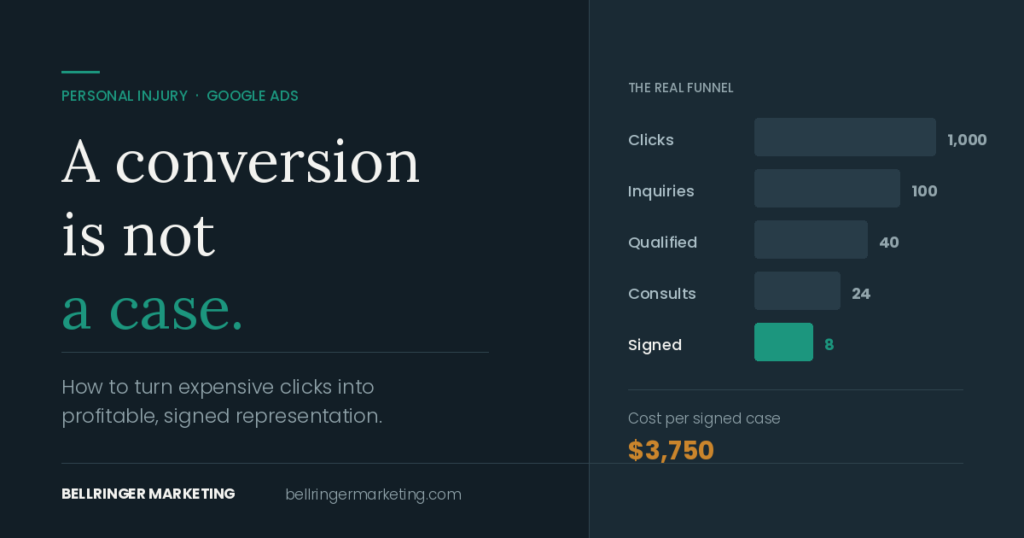
For a personal injury firm, the real journey looks more like this:
The firms that understand this difference have an enormous advantage over firms managing PPC around clicks and lead volume alone.
This guide takes a business-first approach to Google Ads for personal injury lawyers. Instead of simply showing you how to create a campaign, we’ll look at how to decide what to advertise, which cases to pursue, how to allocate money, how to evaluate leads, and how to connect advertising performance to signed cases.
Section 01The Real Goal of Personal Injury PPC
Let’s start with the biggest misconception.
The objective of Google Ads is not to generate leads. The objective is to generate profitable cases.
Leads are simply one stage of the process. Imagine two campaigns with identical budgets.
$10,000 spend
- Leads
- 100
- Qualified leads
- 30
- Consultations
- 5
- Signed cases
- 1
- Cost per lead
- $100
- Cost per signed case
- $10,000
$10,000 spend
- Leads
- 40
- Qualified leads
- 25
- Consultations
- 15
- Signed cases
- 5
- Cost per lead
- $250
- Cost per signed case
- $2,000
If you’re reporting only cost per lead, Campaign A looks incredible. If you’re running a law firm, Campaign B is the obvious winner — five times the cases at a fifth of the acquisition cost.
Stop asking “how many leads did Google generate?” and start asking “how many worthwhile cases did our advertising help us acquire, and at what cost?”
Section 02Why Personal Injury Google Ads Are Different
Personal injury is not an ordinary lead-generation category.
The person searching may have just been involved in a collision, suffered a serious injury, lost wages, received medical treatment, lost a family member, been contacted by an insurance company, or only recently realized they may need legal representation.
That creates a very different search environment. The person isn’t shopping for a product. They’re trying to figure out: “What do I do now?”
That means your advertising has to accomplish two things simultaneously:
- Capture intent. Appear when someone is actively looking for representation.
- Reduce uncertainty. Give that person enough confidence to take the next step.
That is why the best PI campaigns aren’t built entirely around aggressive sales language. They are built around relevance, credibility, and clarity.
Section 03Start With the Case, Not the Keyword
A common PPC workflow starts with: “What keywords should we buy?”
I would start somewhere else: “What cases does this firm want more of?”
For example, a firm might prioritize high-severity auto collisions, commercial vehicle crashes, motorcycle accidents, wrongful death, catastrophic injuries, premises liability, or pedestrian accidents.
Those priorities should drive the advertising strategy, because not every search deserves equal budget. Consider these four searches:
personal injury lawyer car accident attorney truck accident lawyer injury settlement calculator
They may all relate to personal injury. But they don’t represent the same commercial opportunity. The campaign should be built around business priorities first and keyword lists second.
Section 04Build Your PPC Strategy Around Case Economics
Before deciding how much to spend, determine what a new case is worth to the firm. You don’t need perfect numbers on day one. You need a reasonable starting model.
Suppose a firm determines that the average collected fee from a case is $12,000, and the firm wants acquisition costs below 20% of collected revenue. That gives the firm a target acquisition cost — and if roughly 1 in 8 qualified leads becomes a signed client, it also gives you a maximum defensible cost per qualified lead.
Target acquisition cost @ 20% ……… $12,000 × 0.20 = $2,400 per signed case
Qualified lead → signed rate …………. 1 in 8
Maximum cost per qualified lead ….. $2,400 ÷ 8 = $300
Now we have something useful. Instead of saying “our CPL needs to be below $100,” we can ask: “Are we acquiring qualified opportunities at a price the firm’s economics can support?”
That’s a much more intelligent PPC conversation — and it’s the number that should anchor your target CPA in Smart Bidding.
Section 05The Personal Injury Search-Intent Ladder
Not every person searching about an accident is equally ready to hire an attorney. I like to think about searches as a progression.
They may not be looking for a lawyer yet. Informational, high volume, low immediate value.
Legal representation is becoming relevant, but the person is still orienting.
The person is actively evaluating lawyers. Credibility signals matter most here.
Much closer to a direct request for representation. Expensive, and usually worth it.
The person is ready to contact a firm right now. Protect this traffic first.
The mistake is treating every level as equally valuable. A sophisticated campaign understands where the searcher is in the decision process and funds each level accordingly.
Section 06Design Your Campaign Around Client Situations
Instead of thinking “we have a personal injury campaign,” think: “we have several different types of potential clients.”
| Client situation | Representative search themes | Why it needs separation |
|---|---|---|
| Auto accidents | car accident attorney, car crash lawyer, auto accident lawyer | Highest volume; usually the budget anchor |
| Truck accidents | truck accident lawyer, commercial truck accident attorney, 18 wheeler accident lawyer | Different intent, different case value, different competition |
| Motorcycle accidents | motorcycle accident attorney, motorcycle crash lawyer | Distinct audience and liability narrative |
| Wrongful death | wrongful death lawyer, wrongful death attorney | Completely different emotional context; ad tone must change |
| Pedestrian accidents | pedestrian accident attorney, pedestrian injury lawyer | Lower volume, often high severity |
The point isn’t to create hundreds of tiny ad groups just because you can. The point is to make sure the advertising experience reflects what actually happened to the person searching.
Section 07The “Would We Take This Case?” Filter
Here’s a simple question I would add to every PI PPC strategy:
If this person called the firm right now, would we seriously consider taking the case?
Run your search terms through it.
| Search term | Would we take it? | Action |
|---|---|---|
| personal injury lawyer | Maybe | Keep, monitor lead quality |
| car accident lawyer | Probably | Keep and fund |
| personal injury lawyer salary | No | Negative keyword |
| personal injury law school | No | Negative keyword |
| free accident settlement calculator | Rarely | Negative unless proven otherwise |
This is where search-term analysis becomes more than a technical Google Ads task. You’re determining: which people should the firm spend money trying to reach?
Section 08Managing Search Waste
One of the most valuable PPC activities is figuring out where money is going that shouldn’t be going there. Every campaign should have a process for reviewing actual search behavior.
Don’t just look at keyword → clicks → conversions. Look at search query → intent → lead quality → business value, and ask six questions of every inquiry:
- Was the search relevant?
- Did the person become a lead?
- Was the lead legitimate?
- Was there a viable injury claim?
- Did the firm want that type of case?
- Did the person ultimately retain counsel?
That creates a feedback loop between advertising and the law firm’s actual business.
Section 09Write Ads That Speak to Injured People
Personal injury advertising requires a different tone. The person searching may be stressed, confused, or overwhelmed. Your ad needs to answer one question: “Why should I click this law firm instead of the other firms on this page?”
Useful elements include practice-area relevance, location, attorney experience, consultation information, fee structure, availability, and legitimate proof of experience.
But don’t turn every ad into a wall of superlatives. “BEST.” “TOP.” “AWARD-WINNING.” “NUMBER ONE.” Those claims don’t automatically create trust. Specificity is more persuasive.
Experienced Personal Injury Lawyers
Says nothing a competitor couldn’t also claim.
Minnesota Car Accident Attorneys
Immediately tells the searcher: these people handle my situation, in my state.
Any claims involving recoveries, awards, experience, or results should be accurate and compliant with the applicable state attorney-advertising rules. Verify your ad copy against your state bar’s rules on lawyer communications before launch.
Section 10The Click Is Only the Beginning
This is where many PPC campaigns break down. A person searches. They click. Then they land on a page that says “Welcome to Smith & Smith Law.” And that’s it.
The visitor now has to figure out whether the firm handles their case, where the firm is located, whether they should call, whether there’s a consultation, and what happens next. That’s unnecessary friction.
The post-click experience should continue the conversation that began in Google. If someone searched for a car accident attorney, the page should immediately communicate: you are in the right place → here’s how we can help → here’s what to do next.
Section 11Design the Post-Click Experience Around the Decision
Instead of asking “how do we make this landing page convert?”, ask: “what does an injured person need to know before they’re comfortable contacting us?”
| What they need | The question in their head |
|---|---|
| Relevance | “Do you handle my type of accident?” |
| Geography | “Do you represent people in my area?” |
| Credibility | “Why should I trust you?” |
| Process | “What happens when I call?” |
| Cost | “How does payment work?” |
| Action | “How do I speak with someone?” |
A strong page doesn’t need to overwhelm someone with information. It needs to remove the major reasons they might hesitate.
Section 12Your Intake Team Is Part of Your PPC Campaign
This is one of the most overlooked parts of legal advertising.
Imagine paying $300 for a click. That person calls. Nobody answers. The person calls another attorney. You didn’t have a Google Ads problem — you had an intake problem.
The same thing happens when calls aren’t returned, forms aren’t followed up quickly, intake staff don’t know which cases the firm wants, potential clients receive inconsistent information, or consultations aren’t scheduled effectively.
Your advertising system actually looks like this:
If the bottom half of that chain is broken, increasing the top half won’t solve the problem. It will just make the leak more expensive.
Section 13Measure the Entire Client Acquisition Journey
Here’s the reporting model I’d want every PI firm to have.
| Stage | Metric | Where it comes from |
|---|---|---|
| Advertising | Spend | Google Ads |
| Traffic | Clicks | Google Ads |
| Engagement | Landing page behavior | GA4 |
| Inquiry | Calls and forms | Call tracking + form platform |
| Qualification | Qualified leads | Intake team tagging |
| Sales | Consultations | Case management system |
| Outcome | Signed cases | Case management system |
| Economics | Acquisition cost | Spend ÷ signed cases |
| Revenue | Collected case value | Accounting |
This changes the conversation. Instead of “Google generated 63 leads,” you can say: “Campaign A generated 21 qualified opportunities and 4 signed cases at an acquisition cost of $2,100.” That’s actionable.
Section 14A Personal Injury PPC Profitability Model
Let’s build a simple example. Suppose a month produces $15,000 in ad spend, 30 leads, 18 qualified leads, 12 consultations, and 4 signed cases.
Cost per qualified lead ……. $15,000 ÷ 18 = $833
Cost per consultation ………. $15,000 ÷ 12 = $1,250
Cost per signed case ………… $15,000 ÷ 4 = $3,750
Now the attorney can compare that $3,750 acquisition cost against the firm’s actual economics. If the average collected fee is $12,000, acquisition is running at about 31% of revenue — above the 20% target from section 4, and a signal to tighten targeting or improve intake before adding budget.
That’s far more informative than reporting “30 leads at $500 CPL.”
Section 15How to Decide Where Your Budget Goes
Budget should follow opportunity. If one campaign produces 10 signed cases and another produces 1, you shouldn’t automatically give both the same budget.
But there’s another layer.
3 signed cases
- Average case value
- $5,000
- Total value
- $15,000
2 signed cases
- Average case value
- $20,000
- Total value
- $40,000
Campaign A produced more cases. Campaign B produced more economic value. That’s why the final optimization question should be:
Where does the next advertising dollar have the greatest expected business value? — not “which campaign has the cheapest CPL?”
Section 16Why Lead Volume Can Mislead You
Lead volume creates an addictive PPC dashboard. More leads feels like progress. But 50 leads is not necessarily better than 10 qualified cases.
PI firms should be particularly careful about leads such as:
- People outside the firm’s geography
- People without viable claims
- People looking for information rather than representation
- People seeking a practice area the firm doesn’t handle
- Duplicate inquiries and spam
- People who cannot realistically become clients
The goal is not to eliminate every imperfect lead. The goal is to understand where your advertising budget produces legitimate opportunities.
Section 17When a Campaign Is Generating the Wrong Kind of Success
Different symptoms point to different diseases. These are the four patterns I investigate first.
| Symptom | Likely causes |
|---|---|
| High clicks, few leads | Weak landing page, poor message match, mobile friction, weak offer, wrong search intent |
| Many leads, few qualified | Broad targeting, poor keyword selection, inadequate qualification, irrelevant searches |
| Many qualified, few signed | Intake, consultation process, follow-up speed, case selection, economics |
| Good case volume, poor profit | Acquisition cost too high, case values too low, budget behind weaker opportunities |
Each problem requires a different solution. That’s why “optimize Google Ads” is not a strategy by itself.
Section 18The Personal Injury PPC Optimization Loop
I would run the campaign through a repeating cycle rather than reacting to yesterday’s CPC.
- ObserveWhat searches, ads, pages, and campaigns are producing activity?
- ClassifyWhich traffic represents legitimate PI opportunities?
- ConnectWhich opportunities become consultations and signed cases?
- DiagnoseWhere is the funnel losing potential clients?
- ChangeMake one or more targeted improvements.
- MeasureDid the business outcome improve?
- ReallocateMove resources toward the strongest opportunities.
Then repeat. This creates a far more intelligent PPC process than constantly changing bids because CPC went up yesterday.
Section 19A 30-Day Personal Injury PPC Audit
If I inherited a PI Google Ads account tomorrow, I wouldn’t immediately start changing everything. I’d establish a baseline first.
Week 1: Understand the business
Document practice areas, geography, preferred cases, cases the firm doesn’t want, average case economics, intake process, staffing, hours, and existing tracking.
Week 2: Understand the traffic
Review search queries, keywords, match types, locations, devices, campaign structure, budgets, and wasted spend.
Week 3: Understand conversion quality
Connect calls, forms, qualified leads, consultations, and signed cases into one view.
Week 4: Prioritize
Separate every finding into three buckets:
- Stop — things wasting money
- Fix — things preventing good traffic from converting
- Scale — things already producing profitable opportunities
That gives the firm a roadmap instead of a random collection of Google Ads changes.
Section 20What I Would Fix First in a Struggling PI Campaign
If a personal injury campaign is performing poorly, I’d investigate these areas in roughly this order. The order matters.
- Tracking. If the data is wrong, everything else becomes harder.
- Search intent. Make sure you’re buying the right traffic.
- Lead quality. Determine whether the inquiries are legitimate opportunities.
- Intake. Make sure valuable opportunities aren’t lost after the click.
- Campaign allocation. Put money behind the strongest case opportunities.
- Landing experience. Remove friction between the search and the consultation.
- Ad messaging. Improve relevance and differentiation.
- Search-term control. Continue eliminating waste.
- Bidding and budget. Only after the fundamentals are understood.
There’s little value in spending hours adjusting bids if the campaign is counting every form submission as a “conversion” even though most aren’t legitimate cases. You’d be optimizing toward the wrong signal, faster.
Section 21Personal Injury Google Ads FAQs
Are Google Ads worth it for personal injury lawyers?
They can be, but profitability depends on the relationship between advertising cost, lead quality, signed cases, and case economics. The right question isn’t whether PPC produces leads — it’s whether PPC can acquire desirable cases at a sustainable cost relative to your average collected fee.
Why are personal injury Google Ads so expensive?
Personal injury searches are commercially valuable, which attracts substantial competition and drives up cost per click. But the important question isn’t whether a click is expensive in isolation. It’s whether the cost of acquiring the resulting client makes economic sense for the firm.
How much should a personal injury firm spend on Google Ads?
There isn’t a universal budget. Start with the firm’s case economics, available search demand, and desired acquisition volume. Then use actual signed-case performance to determine whether increasing spend makes sense.
What is a good cost per lead for personal injury lawyers?
There isn’t one number that applies to every firm. A $200 lead might be terrible and a $600 lead might be excellent. It depends entirely on qualification rate, consultation rate, signed-case rate, and average case value. Work backward from your target acquisition cost instead of benchmarking CPL against other firms.
Should personal injury lawyers send Google Ads traffic to their homepage?
Not automatically. The destination should match the searcher’s intent and provide a clear path toward contacting the firm. A truck accident searcher landing on a general firm homepage has to do work that a dedicated page would have done for them.
How should a PI firm judge its Google Ads agency?
Don’t ask only “how many leads did you get me?” Ask what percentage were qualified, which campaigns produced them, which cases were retained, what the acquisition cost was, how call quality is being measured, how offline outcomes are being fed back into optimization, and where the budget is going. A good PPC partner should be able to explain the relationship between advertising activity and business outcomes.
How long should a personal injury PPC campaign run before making changes?
Some issues can be identified quickly, such as irrelevant traffic or broken tracking. Other decisions require enough data to distinguish a real pattern from normal variation. The key is to avoid making major strategic decisions from tiny samples — especially in a practice area where signed cases arrive slowly.
Should every personal injury case type have its own campaign?
Not necessarily. The right structure depends on search volume, budget, geography, and the firm’s priorities. The principle is to separate materially different intent when doing so improves control and measurement — not to create complexity just to make an account look sophisticated.
Section 22Final Takeaway: Stop Managing PPC Like a Traffic Channel
Personal injury Google Ads becomes much easier to understand when you stop viewing it as a traffic-generation machine. It is an economic system.
The firm spends money to enter an auction. That produces clicks. Some clicks become inquiries. Some inquiries become legitimate opportunities. Some opportunities become consultations. Some consultations become signed cases. And those cases produce revenue.
The job of PPC management is to understand every step of that chain and improve the weakest link.
Not “what’s our cost per click?” Not even “what’s our cost per lead?” The better question is: what are we paying to acquire the cases we actually want?
Once you can answer that question with reliable data, Google Ads stops being a mysterious marketing expense. It becomes a measurable client-acquisition system — and that’s where serious personal injury firms start making smarter decisions with every advertising dollar.
Want this math run on your own account?
I’ll look at your search terms, conversion setup, and signed-case data, then tell you what your real cost per case is — and which part of the chain is leaking.
Talk to Henry directlyHenry Bell is the founder of Bellringer Marketing, a digital marketing company specializing in Google Ads and lead generation for law firms and service businesses.
His PPC approach focuses on connecting advertising performance to real business outcomes — lead quality, conversion tracking, client acquisition, and profitability — rather than optimizing campaigns around clicks alone.