
Law Firm Marketing Attribution: How to Measure the Leads Your Reports Can’t See.

A man is arrested on a Tuesday afternoon. By Friday he’s your client. Your Google Ads report has no idea you had anything to do with it.

The short version

Law firm marketing attribution breaks because of how legal clients behave, not because of which software you bought. The person who searches often isn’t the person who calls, the call comes days later from a saved number, and intake logs it as a referral. Before you buy anything, measure your own unknown-lead rate from the last 90 days of signed cases — then fix the cheapest gap first.

Here’s the sequence, and every criminal defense and family law attorney reading this has lived some version of it.

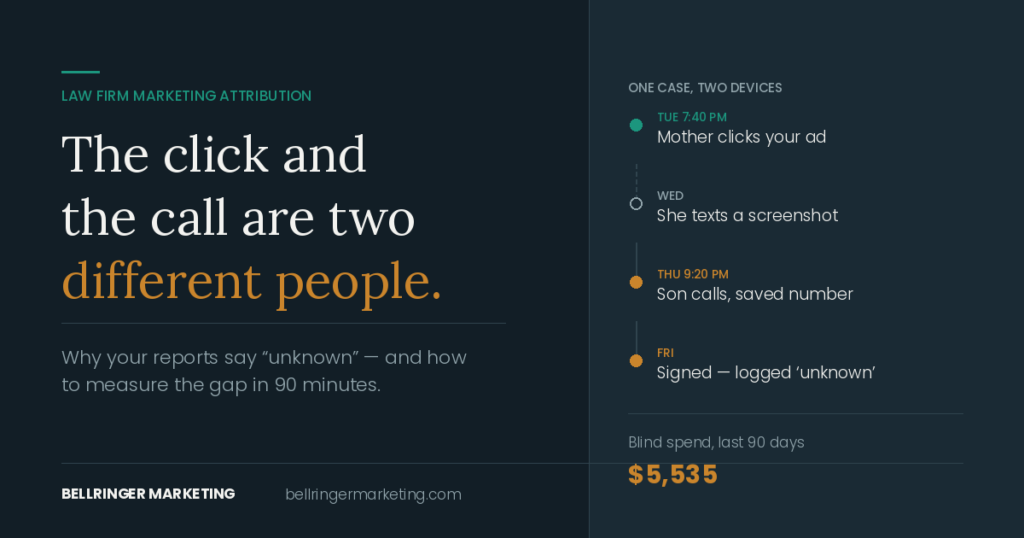
Tuesday, 4:15 p.m. The arrest

Nobody has searched for anything yet.

Tuesday, 7:40 p.m. His mother searches on her phone

She clicks your ad, reads your DUI page and your bio, and doesn’t call — it’s late and she’s not the one who was arrested. She screenshots your number. This is the click you paid for.

Wednesday She texts the screenshot to her son

The number now lives in his messages. No link, no referrer, no tracking parameter — just an image of a phone number.

Thursday, 9:20 p.m. He calls from his own phone

Different person, different device, two days later, from a number that arrived as a picture. This is the call you got.

Friday He retains you — logged as “unknown”

Your ad platform sees a click that never converted and a call that came from nowhere.

There is no tracking software on earth that connects those two events. Not because the software is bad, but because there is no shared identifier between a click on one woman’s phone and a call from her son’s phone forty-nine hours later.

That’s the real problem with law firm marketing attribution, and almost nobody writing about it says so plainly. Most articles hand you an architecture diagram and a shopping list. This one starts somewhere more useful: finding out how big your gap actually is, in about ninety minutes, using data you already have.

Section 01It’s a Behavior Problem, Not a Software Problem

When a firm tells me their attribution is broken, the first instinct is almost always to name a tool. Call tracking. A better CRM. A dashboard that ties it all together.

Tools help. But they can’t fix the underlying issue, which is that legal clients don’t behave like the linear funnel your analytics platform assumes.

Somebody buying running shoes searches, clicks, and buys, usually on one device, usually inside an hour. Somebody hiring a criminal defense attorney searches in a panic at 11 p.m., closes the tab, thinks about it for two days, asks a coworker, searches again by your firm name, and calls from a number they wrote on the back of a receipt.

Every one of those gaps strips the tracking data. Not because anything malfunctioned — because that’s how referrer data works. A phone number typed by hand carries no history. A screenshot carries no history. A brand-name search two days after a paid click looks, to your report, like a person who found you out of thin air.

Attribution doesn’t fail at the moment of the click. It fails in the hours and days between the click and the call, and that gap is where legal clients live.

This matters more for law firms than for most businesses because of how the contact happens. Phone calls remain the dominant intake channel in legal, and the phone is exactly where digital tracking is weakest. Clio’s secret shopper research also found that of 500 firms contacted, only 40% answered the phone and 48% were essentially unreachable by phone (Clio Legal Trends Report) — which means your attribution problem sits on top of an answering problem at a lot of firms.

Section 02The Four Places Attribution Breaks at a Law Firm

In my experience these are the four failure points, roughly in order of how much damage they do.

1. The searcher isn’t the caller

This is the biggest one and the least discussed. In criminal defense, the person researching attorneys is frequently a mother, a spouse, a girlfriend, or an employer — not the defendant, who may be in custody or without their phone. In family law it’s often a parent or a friend doing the research on someone else’s behalf.

Every piece of attribution technology assumes one person, one journey. When the research and the contact happen on two different devices belonging to two different people, there is no identifier to match. Enhanced conversions can’t hash their way to a match, because the email and phone number you eventually collect belong to a person who never visited your site.

2. The lag between the search and the decision

Nobody hires a criminal defense attorney in the four minutes after clicking an ad. There’s a bond hearing to get through, family to consult, money to find. The gap between first click and signed retainer is routinely weeks, and sometimes it stretches past the first court date.

That lag matters mechanically, not just conceptually — Google’s conversion upload windows have hard limits, which I get into in section 7. A case signed too long after the click literally cannot be sent back to Google.

3. The saved number

People screenshot, copy, paste, and hand-write phone numbers. They text your number to the person who actually needs it. They call the number on your Google Business Profile listing instead of the one on your site.

Dynamic number insertion solves part of this — it assigns a different phone number to each traffic source so the call itself carries a signal. But it only works while the visitor stays identifiable from the website session through to the call. Break the session and the number they saved may not be the number DNI would have shown them.

4. The referral overwrite at intake

This one is entirely self-inflicted, which is good news, because it’s the easiest to fix.

A caller says “my cousin told me about you.” Intake writes down “referral” and the record is closed. But the cousin found you through a paid search ad three months ago. Two marketing sources contributed and your CRM now credits one of them — the one you’re not paying for.

Word of mouth is real and valuable. The mistake is letting it overwrite everything upstream of it.

Ad click Cousin remembers firm Recommends you Intake logs “referral” Ad budget cut

Section 03Measure Your Own Gap Before You Buy Anything

You’ll see percentages thrown around for how many law firm leads go unattributed. I’m not going to give you one, because I’ve never seen a defensible study of it and neither has anyone quoting a figure at you.

Your number is knowable, though. It’s sitting in your case management system right now, and it’s worth far more than an industry average, because it’s the one you’ll actually make decisions from.

Block out an afternoon and run this.

The Attribution Gap Audit 90 minutes · no new software required
Pull every signed case from the last 90 days

Export from Clio, MyCase, Filevine, or whatever you use. You want the client name, the sign date, and whatever source field your intake team fills in. Ninety days keeps it recent enough to be actionable and long enough to cover normal signing lag.

Total signed cases:  

Sort each case into one of three buckets

Be strict. If you’re arguing with yourself about which bucket a case belongs in, it goes in the weaker one.

A — Hard-attributed. A tracked click, a tracked call from a dedicated number, or a form submission carrying source data. Machine evidence, not memory. Count:   B — Soft-attributed. Intake logged a source because the client said something. Real information, but unverified and easily wrong. Count:   C — Unknown. Blank, “direct,” “website,” “Google” with nothing behind it, or “referral” with no named referrer. Count:  
Calculate your unknown rate

Divide bucket C by your total. That percentage is the share of your actual business you cannot trace to a marketing decision.

Convert it to dollars

Multiply your 90-day ad spend by your unknown rate. I call this figure blind spend — the money you put into the market during that period that produced results you can’t connect to anything. It’s the number to bring to a budget conversation, because a percentage is an abstraction and a dollar figure is not.

Here’s the arithmetic on a firm signing about a case a week:

Signed cases, last 90 days ……….. 34
A — hard-attributed ………………… 11
B — soft-attributed ………………… 9
C — unknown …………………………… 14

Unknown rate ……. 14 ÷ 34 = 41%
90-day ad spend … $13,500
Blind spend ……… $13,500 × 0.41 = $5,535

That last line is the one that changes behavior. It isn’t “our tracking could be better.” It’s five and a half thousand dollars in one quarter going somewhere you can’t see.

Why bucket B matters

Don’t merge soft-attributed cases into your “we know” pile. Bucket B is the group most likely to be quietly wrong — it’s where the referral overwrite lives, and where “I found you on Google” gets logged as organic when it was a paid ad. Keeping it separate tells you how much of your confidence rests on what clients remember.

Section 04What Your Number Actually Means

These bands are practitioner judgment from accounts I’ve worked on, not published research. Treat them as a starting read, and weight your own trend over any benchmark — your number moving from 45% to 25% matters more than where it sits against someone else’s firm.

Under 25% Don’t buy anything yet

Your tracking is working. Spend your effort on intake logging discipline and getting signed-case data flowing back to your ad platform, not on new software.

25–45% One or two real gaps

Usually a missing tracking number on the Google Business Profile, forms not passing source data, or intake logging into a free-text field. Fixable in a couple of weeks.

Over 45% Structural

You’re making budget decisions on a coin flip. Start with the cheapest fixes below — resist the urge to buy a platform, because a platform can’t fill data you never captured.

One thing worth naming: a high number is not evidence that your marketing is failing. It’s evidence that you can’t tell. Those are very different problems, and firms cut budget over the first one when they actually have the second.

Section 05Fix One: The Two Phone Numbers You’re Missing

This is the cheapest meaningful fix available to a small firm, and most firms have only done half of it.

A dynamic pool on the website

Dynamic number insertion swaps the phone number shown on your site based on how the visitor arrived. Someone from a paid search ad sees a different number than someone from organic. When the phone rings, the number dialed tells you the source without asking anyone anything.

If you take a meaningful share of your inquiries by phone — and in criminal defense you do — this is the single highest-leverage tracking investment available to you.

A dedicated static number on your Google Business Profile

This is the half that gets skipped, and it’s often the larger hole.

A great deal of legal search traffic never reaches your website at all. Someone searches your firm name, your listing appears, and they tap the call button straight from the search results. That call bypasses every piece of tracking on your site.

The fix is a single dedicated tracking number listed as the primary number on the profile, forwarding to your main line, with your real number kept as an additional number so your listing stays consistent with your citations elsewhere. Use a static number here, not a dynamic pool — the profile needs a stable, consistent number.

Do this part carefully

Changing the primary number on a Google Business Profile can trigger re-verification and, done sloppily, can affect local ranking. Keep the original number listed as an additional number, change one thing at a time, and don’t do this the same week you make other listing edits.

Section 06Fix Two: The Intake Question, and Where to Put It

Technology captures what happened online. A person has to capture the rest. That’s not a workaround — for the mother-searches-son-calls scenario, a human asking a question is the only instrument that can recover the source.

Three things determine whether this works.

Ask two questions, not one

“How did you hear about us?” collapses a multi-touch journey into one answer. Split it:

  • “How did you first come across our firm?” — captures the origin, which is usually the marketing you paid for.
  • “What made you decide to call today?” — captures the trigger, which is often the referral or the second search.

Both are true. Neither should erase the other, and a firm that records only the second one will systematically underpay for the marketing that created the first.

Ask late in the call, not first

A person calling about an arrest is frightened. Opening with a marketing question is tone-deaf and produces a throwaway answer. Ask it after rapport is built, near the end, conversationally — right around when you’re confirming contact details. Answer quality goes up sharply.

Log into fixed categories, never free text

Free text gives you “google,” “Google”, “google ads,” “online,” and “internet” as five separate values describing one thing. Use a short dropdown — Google search, Google ad, Google Maps listing, referral from a person, referral from another attorney, returning client, other — and make the field required.

Key takeaway

An intake team that logs source data consistently is worth more than most attribution software, and costs nothing but a script change and a dropdown field.

Section 07Fix Three: Feeding Signed Cases Back to Google

Everything above improves what you know. This step improves what your campaigns do, and it’s where most law firm setups quietly fail.

Google’s Smart Bidding optimizes toward whatever conversions you report. If you’re reporting form fills and phone calls, it will find you more form fills and phone calls — including from people who will never become clients. Feed it signed cases instead and it starts hunting for the auctions that produce clients.

That’s the pitch you’ve heard. Here’s the part almost nobody mentions, and it’s the part that bites criminal defense firms specifically.

The upload window is a hard deadline

Google enforces time limits between the original ad click and the conversion upload. Per Google’s own documentation, a conversion uploaded with a GCLID has to arrive within 90 days of the click, and one uploaded with hashed personal data for enhanced conversions has to arrive within 63 days. Past 63 days, an enhanced conversion lead simply won’t be imported.

Now put that against a criminal defense timeline. Click in early March. Arrest processing, bond, family discussions, money. Retainer signed in late May. That’s past 63 days, and the case you most wanted to teach Google about is the one it will refuse to accept.

Signing lag after the clickWhat you can upload
Under 63 daysSigned case, with value. The ideal signal.
63–90 daysGCLID-based upload only. Enhanced conversions will reject it.
Over 90 daysNothing. The case is invisible to bidding, permanently.

The practical answer for slow-signing practice areas is to stop waiting for the signature. Pick a milestone that reliably happens inside the window and predicts signing — consultation attended, or retainer agreement sent — and upload that as your optimization conversion, with a value equal to your average case fee multiplied by the rate at which that milestone converts. You still track signed cases for your own reporting. You just stop asking the bidding algorithm to wait three months for a lesson.

If you already have an upload running

Google is moving offline conversion imports and enhanced conversions for leads to the Data Manager API, with uploads through the legacy Google Ads API path being blocked as of mid-2026. If your firm’s pipeline was built on the older API method, confirm with whoever built it that it’s been migrated — a silently failing upload looks exactly like a campaign that stopped producing cases.

Section 08What Attribution Will Never Recover

Any consultant who tells you they can get to complete attribution is selling something. Some of your unknown bucket is permanently unknowable, and knowing which part saves you from spending money chasing it.

  • Cross-person journeys. When one person researches and another calls, there is no identifier connecting them. Only an intake question recovers this.
  • Offline word of mouth. A conversation in a barbershop leaves no digital trace, ever.
  • Brand-name searches after a paid click. Someone who sees your ad, remembers your name, and searches for you directly next week will land in organic or direct. This is your paid campaign working, recorded as something else.
  • Answers clients get wrong. People genuinely do not remember whether they clicked an ad or a map listing, and they will answer confidently either way.

The goal isn’t a complete picture. It’s a picture complete enough to allocate the next dollar with more confidence than a coin flip — and to know which parts of the remaining fog are fog by nature.

Section 09A 30-Day Sequence for a Firm With No Marketing Staff

Ordered so each step is useful on its own. If you stop after week two, you’ve still meaningfully improved your position.

  1. Week 1Run the audit. Get your unknown rate and your blind spend figure in writing.
  2. Week 2Add the dedicated number to your Google Business Profile. Add the two intake questions and the dropdown field.
  3. Week 3Set up dynamic number insertion on the site. Add hidden source fields to every contact form.
  4. Week 4Connect call and form data into your case management system so source travels with the record. Then pick your upload milestone and start feeding it back.

Re-run the audit after 90 days. That second number is the one that tells you whether any of this worked.

Section 10The One Question to Ask Your Agency

If you already have someone managing your Google Ads, this single question will tell you most of what you need to know about how they’re measuring your account:

“How do you connect a signed case back to the ad that influenced it, when the client called four days later from a number they’d saved?”

What you’re listening for is whether they mention uploading outcomes back into the platform, the timing constraints involved, and what your intake team’s role is. A good answer includes at least two of those three, and probably includes a caveat about what they can’t recover.

If the answer is a version of “we look at the conversions column in Google Ads,” your reporting is built on the visible fraction of your results — and the visible fraction, in a practice area where people call from saved numbers, tends to be the smaller half.

Section 11Law Firm Marketing Attribution FAQs

What is law firm marketing attribution?

It’s the practice of connecting a signed case back to the marketing that produced it — which search, which ad, which page, which call. For law firms specifically it’s harder than in most industries, because inquiries arrive by phone, the person searching often isn’t the person who calls, and the decision takes days or weeks rather than minutes.

What percentage of law firm leads are typically unattributed?

There’s no credible published figure specific to law firms, and any article quoting one should be read skeptically. What matters is your own rate, which you can calculate in an afternoon from your last 90 days of signed cases. Your own number is both more accurate and more useful than any benchmark.

Is call tracking worth it for a small law firm?

If a meaningful share of your inquiries come by phone, yes — it’s usually the highest-return tracking spend available, and it’s inexpensive relative to what a single case is worth. Just don’t stop at the website. A dedicated tracking number on your Google Business Profile often captures more missing volume than the website pool does.

Will call tracking hurt my local SEO?

Not if it’s done correctly. Keep your original number listed as an additional number on the Google Business Profile so your listing stays consistent with citations elsewhere, and use a stable static number rather than a rotating pool on the profile itself. Changing the primary number can trigger re-verification, so make the change deliberately and on its own.

Why do my Google Ads conversions not match what my intake team reports?

Usually because the two systems are counting different things at different times. Google counts a conversion at the moment of the click-driven action and attributes it back to the click date; your intake team counts an inquiry when the phone rings, and a case when it signs — often weeks later. Add cross-device and cross-person journeys and a gap between the two numbers is expected. A large and growing gap is the signal worth investigating.

Do I need a CRM to fix attribution?

No. You need source data to survive from the first contact through to the signed case, and a case management system most firms already have can do that if the source field is required and consistently filled. A CRM makes it smoother; it doesn’t create data your intake process never captured.

How long does it take to see improvement?

Intake logging and the Google Business Profile number improve your data within weeks. Feeding outcomes back into Smart Bidding takes longer to show up in performance, because the algorithm needs enough conversion volume to learn from — in a low-volume practice area, expect a couple of months before the effect is readable.

Section 12The Bottom Line

If your reports show more “unknown” and “direct” than you’d like to admit, that’s usually not a marketing performance problem. It’s a measurement visibility problem, and the two get confused constantly — which is how firms end up cutting budget from campaigns that were quietly working.

Fixing it doesn’t require spending more. It requires connecting the dollars you’re already spending to the cases they influenced, so you can put more behind what works and stop under-funding what only looks like it isn’t.

Start with your own number. Everything else is easier to decide once you know it.

Want a second opinion on how much of your lead data is going untracked?

I’ll look at your call tracking setup, your intake fields, and how your conversions are configured, then tell you what your unknown rate looks like and which gap is costing you the most.

Talk to Henry directly
About the author

Henry Bell is the founder of Bellringer Marketing, where he builds Google Ads and lead tracking systems for law firms and service businesses.

He works primarily on attribution infrastructure — call tracking, intake workflows, and feeding signed-case outcomes back into ad platforms so campaigns optimize toward retained clients rather than raw inquiries.

More PPC Marketing Blogs

Law Firm Google Ads Not Converting? It’s Your Tracking

Your Google Ads dashboard says the campaigns are working. Clicks are up. “Conversions” are up. The phone rings. But the calls are wrong. Price shoppers asking about payment plans before they say hello. People who thought they were calling a different firm. Cases you don’t take and have to refer

Read More »