
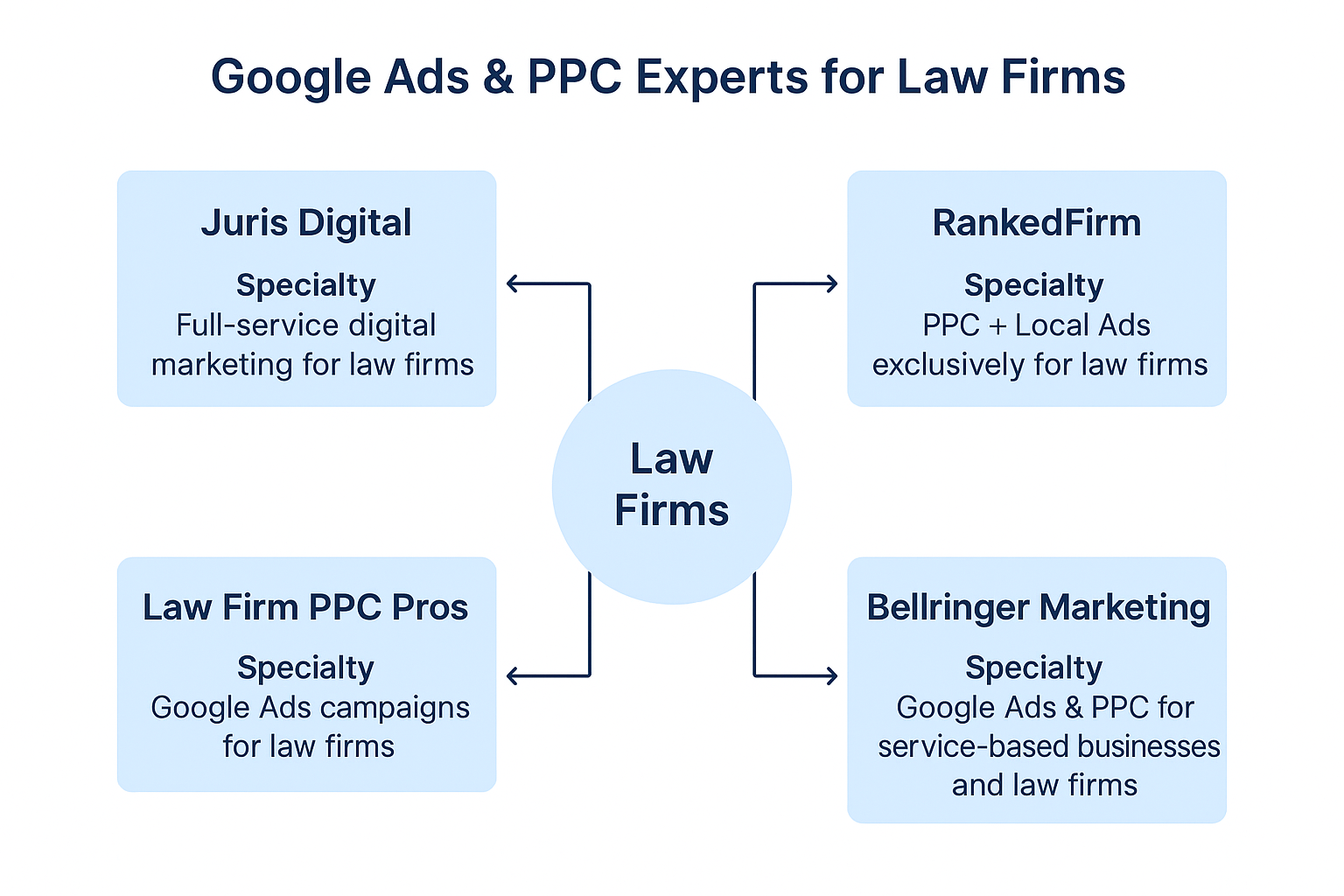
Upfront disclosure: I run one of the four firms below. You should read everything I say about the other three with that in mind. I’ve tried to describe them the way I’d want a competitor to describe me — including the parts where they’d be a better fit for you than I would.
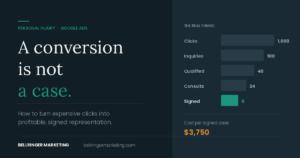
Choosing a Google Ads agency for your law firm comes down to one question that almost nobody asks in the sales call: can you show me cost per signed case for a firm like mine? Not impressions. Not clicks. Not cost per lead. Signed cases.
Legal is the most expensive category in paid search. Clicks in personal injury and criminal defense routinely run into the hundreds of dollars in competitive markets, which means a mediocre setup doesn’t cost you a little — it costs you a case’s worth of budget a month. The gap between an agency that tracks form fills and one that tracks retainers is the entire return on your spend.
Below: the questions to ask before you sign, the red flags that should end a conversation, and an honest look at four firms that specialize in legal PPC — organized by what kind of partner they are, not ranked.
The short version
- You must own your Google Ads account. If the agency owns it, leaving costs you every year of conversion history you paid to build.
- Ask whether they’ll connect your intake CRM back to Google Ads. Most won’t. It’s the difference between optimizing for calls and optimizing for retainers.
- Percentage-of-spend fees pay your agency more when your budget grows, whether or not your case count does.
- Any agency that hasn’t mentioned your state bar’s advertising rules hasn’t run many legal accounts.
8 questions to ask before you sign
Bring these to every call. The answers will separate the specialists from the generalists faster than any case study deck.
1. Who owns the Google Ads account?
The answer must be you. If the agency owns it and you leave, you lose every conversion record, every negative keyword list, and every year of learning data you paid to build. This is the single most expensive thing law firms get wrong, and it only bites at the moment you’re already unhappy.
2. Will you connect my intake CRM back to Google Ads?
This is offline conversion tracking, and it’s the question that separates real legal PPC from generic PPC pointed at a law firm. Without it, Google optimizes toward phone calls — and treats a price shopper and a $10,000 retainer as identical. Most agencies will say “we track calls.” That’s not the same answer — here’s why call tracking alone falls short.
3. Show me cost per signed case for a firm like mine.
Not cost per lead. Not cost per click. If they can’t produce that number for any client, they aren’t measuring what you care about — which means neither will your account.
4. Who actually works on my account day to day?
The person in the pitch is often not the person in the account. Ask directly, ask how many other accounts that person handles, and ask what happens when they leave.
5. How is your fee structured?
Flat fee, percentage of spend, or performance-based. Percentage of spend isn’t disqualifying, but understand what it incentivizes: your manager earns more when your budget grows, regardless of whether your case count does.
6. What’s the contract term and the exit?
Ask about minimum commitment, notice period, and whether setup fees are forfeited if you leave early. A long lock-in on a channel that takes 90 days to evaluate is a bad combination.
7. What do you know about my state’s advertising rules?
Disclaimers on past results, restrictions on “specialist” and “expert,” limits on testimonials, ad record-retention requirements. If this is the first they’ve thought about it, they’ve been running your ads the way they’d run a plumber’s. (More on this in the compliance section below.)
8. What would make you tell me to stop spending?
The best answer is a specific one. An agency that can’t name a scenario where they’d advise you to cut budget or leave the channel is an agency whose incentives never point away from your wallet.
If you only ask two, ask 1 and 2. They predict the rest.
Red flags that should end the conversation
- Guaranteed case volume or guaranteed rankings. Nobody controls the auction or the courts. A guarantee on their own deliverables — tracking built, reports delivered, response times — is legitimate. A guarantee on your case count isn’t.
- They own the account “for efficiency.” There is no efficiency argument that survives the question “so what happens to my data if I leave?”
- Reports that lead with impressions and clicks. A report that opens with reach is a report designed to look busy.
- They can’t explain what a conversion is set to. If nobody on the call can tell you exactly what actions are being counted and whether duplicates are excluded, your numbers are decorative. Broken conversion tracking is the most common reason law firm ads look like they aren’t working.
- Pressure to sign before you’ve seen the account structure they propose.
- Bundled media spend. Your ad budget should go to Google from your card, visible to you. Agencies that bill you one number covering both fee and spend can hide the ratio.
Four kinds of partner — which one fits you
“Best agency” is the wrong frame. These firms aren’t competing for the same client; they’re built for different situations. Find your row first.
| Type | Fits you if | Trade-off |
|---|---|---|
| Full-service legal agency | You need SEO, content, website, and ads under one roof and have budget for all of it | Paid search is one of several priorities, not the priority |
| PPC-only legal specialist | Your website and SEO are handled; you want depth on ads and intake conversion | You’ll need someone else for broader digital strategy |
| Done-for-you / fast launch | You want speed and minimal involvement, and you’re mid-sized enough to absorb a standardized build | Standardization means less customization to your practice mix |
| Owner-operator specialist | You want the person who built it to be the person running it, and direct access without account managers | Limited capacity; no bench if that person is unavailable |
The four firms
Listed by partner type, not ranked. Everything here comes from each firm’s own published material — verify claims directly with them, including mine.
Juris Digital
Full-service legal agency · Denver, CO · serving firms nationwide · jurisdigital.com
Works exclusively with law firms and legal service providers, covering SEO, paid search and Local Services Ads, website design and conversion work, and legal content strategy. Their positioning emphasizes case intake outcomes rather than traffic, and they publish client results including a large traffic and lead-volume increase for a personal injury firm — figures worth asking them to substantiate, as you should with any agency’s published numbers.
Good fit if: you want one partner across SEO, content, website, and ads, you’re past the DIY stage, and you’re in a competitive practice area where the total investment justifies a full-stack approach.
Less good fit if: paid search is the only thing you need. You’d be buying capability you won’t use, and a specialist will go deeper on the ads themselves.
Law Firm PPC Pros
PPC-only legal specialist · remote, US and Canada · lawfirmppcpros.com
Google Ads campaigns built exclusively for law firms, with landing pages and intake automation included in scope. Their messaging centers on signed clients rather than lead volume, and they cover keyword research, ad copy, tracking, landing pages, and follow-up automation as a package.
Good fit if: your website and SEO are already handled, you want narrow scope done well, or you operate across the US and Canada and need someone who works in both markets.
Less good fit if: you need broader digital strategy — SEO, brand, multi-channel — in which case you’ll be adding a second vendor.
RankedFirm
Done-for-you / fast launch · US, remote · rankedfirm.com
PPC and local ads for law firms on a fully managed model — setup, landing pages, tracking dashboards, and Local Services Ads handled end to end, with dedicated account managers and live reporting. They advertise a roughly one-week launch timeline.
Good fit if: you’re a mid-sized firm that wants to move fast, prefers minimal involvement in the mechanics, and values a dedicated account manager and dashboard access.
Less good fit if: your practice mix is unusual enough that a standardized build won’t map to it cleanly.
Worth asking: they use guarantee language in their marketing. Ask precisely what is guaranteed and what the remedy is — a guarantee on their own deliverables is meaningful; a guarantee on your case volume isn’t something any agency can control.
Bellringer Marketing
Owner-operator specialist · Minnesota, clients nationwide · Google Ads for lawyers
That’s me. Google Ads for law firms with a focus on personal injury and criminal defense, built around one metric: revenue returned per dollar spent. The work I’m known for is the tracking pipeline — call tracking, Tag Manager, intake CRM integration, and the automation that sends signed cases and their fee values back into Google Ads, so the algorithm optimizes toward retainers instead of ringing phones. You run the account, you own it, and you work with me rather than a junior handed the file.
Good fit if: your ads produce calls but not cases, your reporting can’t connect a signed retainer to a keyword, or you want direct access to the person doing the work.
Less good fit if: you need SEO, content, and website work bundled in — I don’t do those, and I’ll tell you to hire someone who does. I’m also one person, which means finite capacity and no bench. If you need 24/7 account manager coverage or you’re a multi-office firm requiring a team, one of the others above is the better call.
If you want to see the tracking work before you talk to anyone, here’s what it produced on a criminal defense account and on a personal injury account.
What legal PPC management costs
Two separate numbers, and agencies sometimes blur them: the management fee you pay the agency, and the media spend that goes to Google. Insist on seeing both separately.
On media spend, legal is unforgiving. Personal injury and criminal defense carry some of the highest costs per click in all of paid search, and that has a practical consequence: a budget that would run a healthy campaign for a home service business buys very little in legal. You need enough monthly conversion volume for the bidding system to learn from — roughly 30 conversions a month is the working threshold — and in a category where clicks are expensive, that sets a real floor.
On fees, ask which structure you’re being offered and what’s included. Tracking setup, landing pages, and CRM integration are sometimes bundled and sometimes billed separately as a one-time build. Get it in writing.
More detail on how I structure this: Google Ads management pricing.
Compliance questions specific to law firms
This is where generalist agencies get law firms into trouble, and it almost never comes up in a sales call. Most states base their rules on the ABA Model Rules of Professional Conduct, but the details vary by state, so treat this as a list to raise with your own bar — and with any agency you’re considering.
- Past results. Many states require a disclaimer that prior results don’t guarantee a similar outcome. That’s difficult inside a Google Ads headline and easier on the landing page — an argument for keeping results claims off the ad itself.
- “Specialist” and “expert.” Restricted in many jurisdictions absent a recognized certification. “Focused on” and “practice limited to” are usually safer.
- Superlatives. “Best,” “top,” “#1” invite scrutiny under rules against misleading communications — and they’re weak ad copy regardless.
- Testimonials. Restricted or disclaimer-dependent in a number of states.
- Record retention. Some states require keeping copies of advertisements. Responsive search ads assemble headline combinations dynamically, which makes “what did the ad say” harder to answer than it used to be. Ask how your agency archives assets.
- Remarketing. Google’s personalized advertising policy restricts targeting around sensitive categories, and legal status and criminal history sit in that territory. Defense firms especially should confirm current policy before building audience lists.
None of this is legal advice — you’re the lawyer. But an agency that has never raised any of it probably hasn’t run many legal accounts.
Frequently asked questions
What should I look for in a Google Ads agency for my law firm?
Three things above all. First, that you own the Google Ads account, not the agency — otherwise leaving costs you every year of conversion data you funded. Second, that they’ll connect your intake CRM back to Google Ads so the algorithm optimizes toward signed retainers rather than phone calls. Third, that they can show cost per signed case for an existing client, not cost per lead or cost per click.
Should a law firm hire a legal-specialist agency or a general PPC agency?
A specialist, in most cases. Legal has constraints a generalist won’t anticipate: state bar advertising rules, restrictions on remarketing around sensitive categories, and a long gap between click and signed retainer that breaks standard attribution. A generalist can run competent campaigns, but usually optimizes toward leads because that’s what they can measure.
Is a percentage-of-spend fee bad for law firms?
Not automatically, but understand the incentive. Your manager’s income rises when your budget rises, whether or not your signed-case count follows. Flat fees don’t create that tension. If you do agree to a percentage, ask what happens to the fee if they recommend cutting spend — the answer tells you a lot.
Can an agency guarantee cases from Google Ads?
No. Nobody controls the ad auction, your competitors’ budgets, or whether a caller retains. What an agency can legitimately guarantee is its own deliverables — tracking built and verified, response times, reporting cadence, account ownership. Treat a guarantee on case volume as a sales device rather than a commitment.
How long before I can judge a new legal PPC agency?
Around 90 days. Legal matters commonly take 30 to 60 days from first click to signed retainer, so work done in month one shows up in month two or three. Automated bidding also needs a few weeks to stabilize after changes. Be wary of contracts that lock you in far longer than the time it takes to evaluate the work.
How to actually decide
Pick your partner type from the table, then take the eight questions to two or three calls. The firm that answers question 2 with real specifics — how they’d connect your CRM, what they’d count as a conversion, how they’d handle the delay between click and retainer — is usually the one to hire, whichever name is on the door.
And if you’re currently with an agency, ask them question 1 today. You’d rather find out now than the week you decide to leave.
About the author
Henry Bell runs Bellringer Marketing, managing Google Ads for law firms with one metric in mind: revenue returned per dollar spent. He builds the call tracking, tag, CRM, and automation pipelines that connect signed cases back to the clicks that produced them.
Related reading
- Law firm Google Ads not converting? It’s your tracking — the problem question 2 solves
- Law firm marketing attribution — how to measure the leads your reports can’t see
- Google Ads for personal injury lawyers
- Why some law firms fail at marketing
- Google Ads management pricing